
As a career snowboard instructor, I’ve introduced snowboarding to thousands of beginners and helped countless others progress their skills.
Too many times I’ve seen beginner snowboarders being held back by their equipment. This is most often due to having a snowboard that is too advanced or the wrong size.
This article will dive into the topic of snowboard profile and guide beginners towards choosing the best profile to support them as they learn.
What is Snowboard Profile?
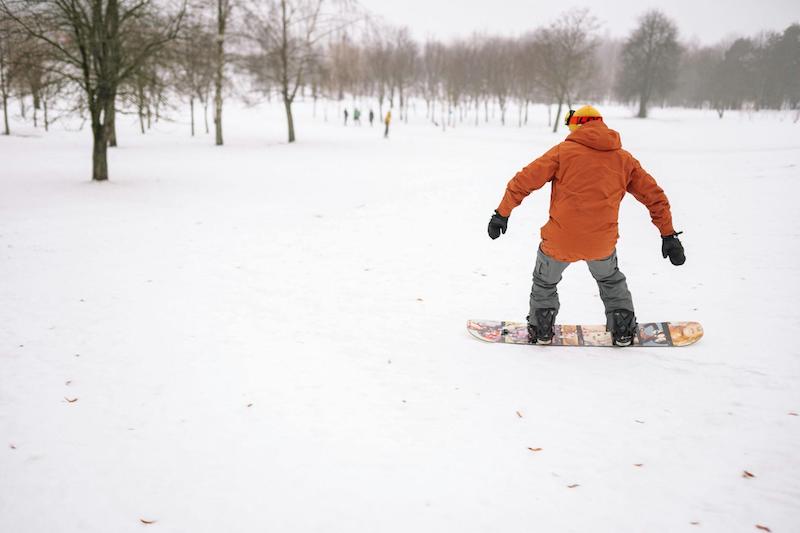
A snowboard profile is the way the snowboard is designed to bend from the contact points, i.e., the places where the board touches the snow when laid flat and without a rider strapped in and pushing down on it.
There are four main categories of profile:
- Camber
- Reverse camber, aka rocker
- Flat
- Hybrid camber
Keep reading for a brief overview of each type of profile.
Camber
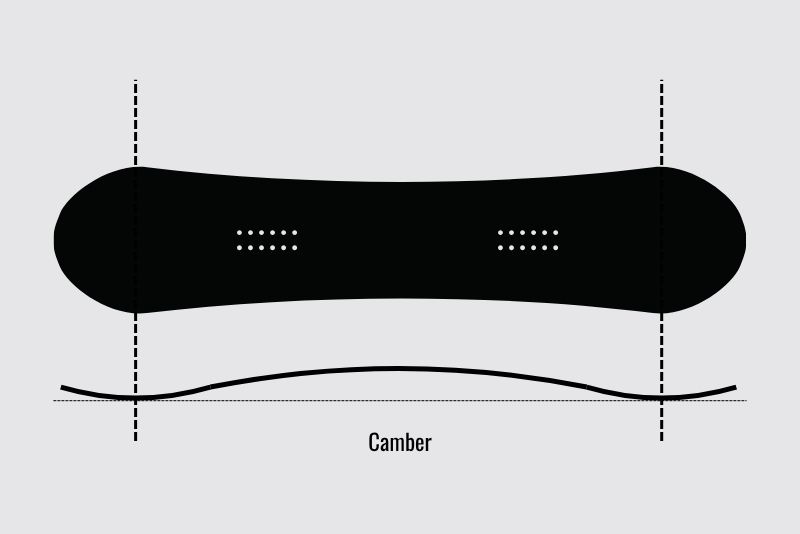
A traditional camber profile has two contact points which are just before the nose and tail start to scoop upwards.
The space between those two contact points, aka the effective edge, is designed to bend upwards with the highest point being exactly in the center between the two contact points, like a bow.
This upward bend is called traditional camber. It can be helpful to think of camber as a spring; when a snowboarder pushes down on it, the snowboard wants to spring back to its bowed position.
When this spring is loaded through forces pushing down on the center of the bow such as what happens in a turn, energy is stored. A skilled snowboarder can create and release that energy at key moments to create dynamic riding.
The trade off to this is that the contact points near the nose and tail make it easier to catch an edge while turning if the body position and sequence of movements isn’t quite consolidated.
That means, traditional camber snowboards are better suited for intermediate riders, who already have some consolidated skills, and are not at the beginner or novice levels.
To learn more about skill levels in snowboarding, read our article What Level of Snowboarder Am I?
Reverse Camber, aka Rocker
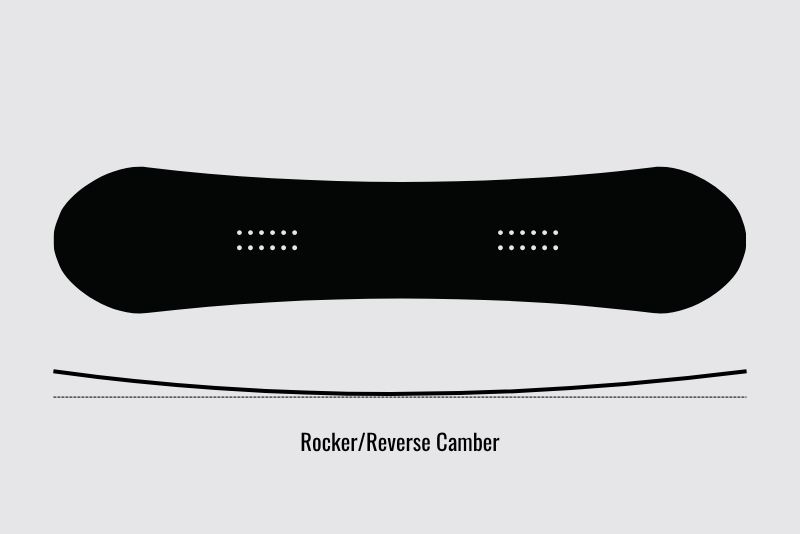
As you might have guessed, a snowboard with reverse camber bends in the opposite direction as traditional camber. There is one contact point and the board rises from that point without being pulled down by another contact point.
A fully-rockered board, i.e., a snowboard with one, center contact point, feels very “loose” as it’s easy to pull up the nose and the tail. This can be useful in certain conditions, like when riding powder or doing flatland tricks, aka butters.
The fact that the main contact point is in the center of the board and not at the nose makes it less likely to catch an edge when learning to turn, because when we turn, we initiate the turn with the front of the board.
For this reason, boards which are either full rockered or just have a bit of reverse camber at the nose (i.e., hybrid camber) are better for beginners than full-traditional camber.
Throughout my years of snowboard instructing, I’ve seen many beginners fall into the bad habit of “turning with the tail,” rather than initiating turns with the nose, or front foot. For this reason, having a rockered tail can also help in minimizing edge catches.
Flat camber
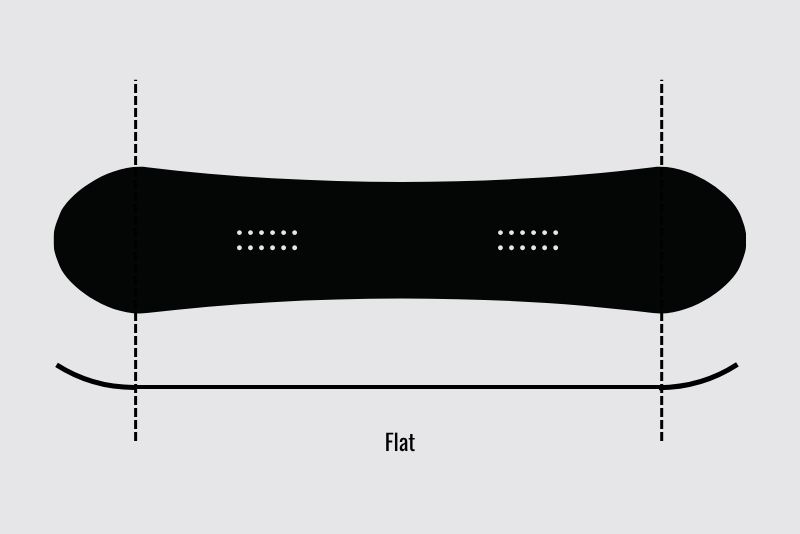
Flat camber is just as it sounds, neither bent upwards or downwards, but built to sit completely flat when laid down on the snow. The entire length of the board is one long contact point, until the nose and tail start to curve upwards.
This means that it isn’t really possible to build and store energy, like we can with traditional camber, and the nose doesn’t naturally bend upwards to keep us afloat in powder like rocker.
However, there aren’t any forces pushing the nose of the board towards the snow, similar to rocker, and so flat camber boards can also be a way to minimize the chance of catching edges while learning and consolidating turns and can be a great profile choice for beginners.
Hybrid camber
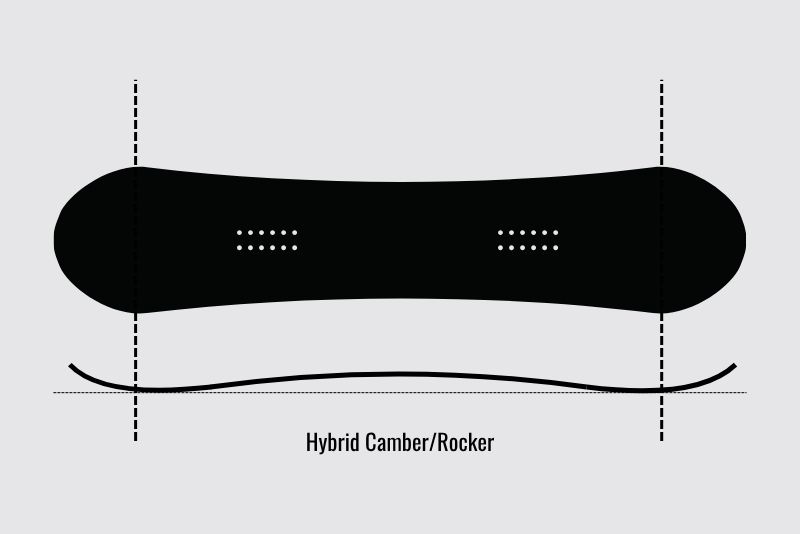
Snowboards with hybrid camber have a mix of two or more of the above camber types at strategic places on the board.
Some common designs that exist are:
- Traditional camber between the bindings with a rockered nose and tail, such as the Salomon Huck Knife.
- Traditional camber between the bindings with a small flat camber after the bindings moving to a rockered nose and tail, like Capita’s Flat Kick Tech.
- Traditional camber through most of the board, including the tail, and a rockered nose, which is common to find in directionally shaped boards.
- Traditional camber under the bindings, aka under-foot, rocker between the bindings and rocker at the nose and tail, like Burton’s Flying V profile.
Hybrid camber snowboards with rockered noses can be good for beginners as they minimize the likelihood of catching edges when turning.
Conclusion: Which snowboard profile is best for beginners?
Instructor Insight: For beginners, the most forgiving snowboard profile would be hybrid camber or flat camber as they minimize the likelihood of catching edges while turning.
If you have one of these boards and are still catching edges, it’s likely due to technique.
If you want to invest in a board that will support your progression beyond the beginner stage and into low-intermediate, consider getting something with a bit of traditional camber.
Traditional camber allows a snowboarder to create and release energy for more dynamic riding. Snowboarders need to be at the intermediate level to begin to experiment with this type of riding.
Alongside the snowboard profile, there are other specs to consider when choosing the best snowboard for your ability level.
For our beginner board recommendations, check out our article Best Beginner Snowboards.