
Choosing your first snowboard can be as overwhelming as it is exciting! There are a ton of different snowboards available on the market today, each with marketing campaigns designed to entice you.
This guide will serve to help you navigate the market and help you, the beginner snowboarder, to choose the right board.
Read More: Best Beginner Snowboards – our curated picks
The most important specs to consider when choosing a snowboard
Every snowboard comes with a spec sheet which lists all the design details of the board. Some specs are more important than others when it comes to choosing a beginner board.
The following sub-sections will go over the most important specs to consider one by one and in order of importance.
Without further ado, let’s drop in!
Board size
Board size is the most important spec to consider when choosing a snowboard.
Board length should be somewhere between your shoulder height and your nose. The main reasons to choose boards towards the shorter and longer end of this range are as follows:
- Taller boards prioritize stability over agility.
- Shorter boards prioritize agility over stability.
After choosing a snowboard that falls within your shoulder to nose height range, the next spec to check is the recommended weight range for the chosen length. Your body weight should fall somewhere within the range.
For a full run-down on how to choose the right size of snowboard, read our dedicated article, “What Size Snowboard Do I Need? (Height vs Weight Explained).”
Board width
Many snowboards come in two variations: regular and wide width. Mid-wide versions of some boards also exist.
These boards exist because it’s best to avoid unwanted heel or toe drag when turning, which can result in “booting out,” i.e., losing your edge grip and falling due to your boots touching the snow while turning.
The rule of thumb is that people with feet between US Men’s Size 10 and 11, and US Women’s Size 9 and 10 should consider mid-wide boards. People with feet larger than that should consider wide boards.
Read More: Snowboard Boot Sizing Guide
Board flex
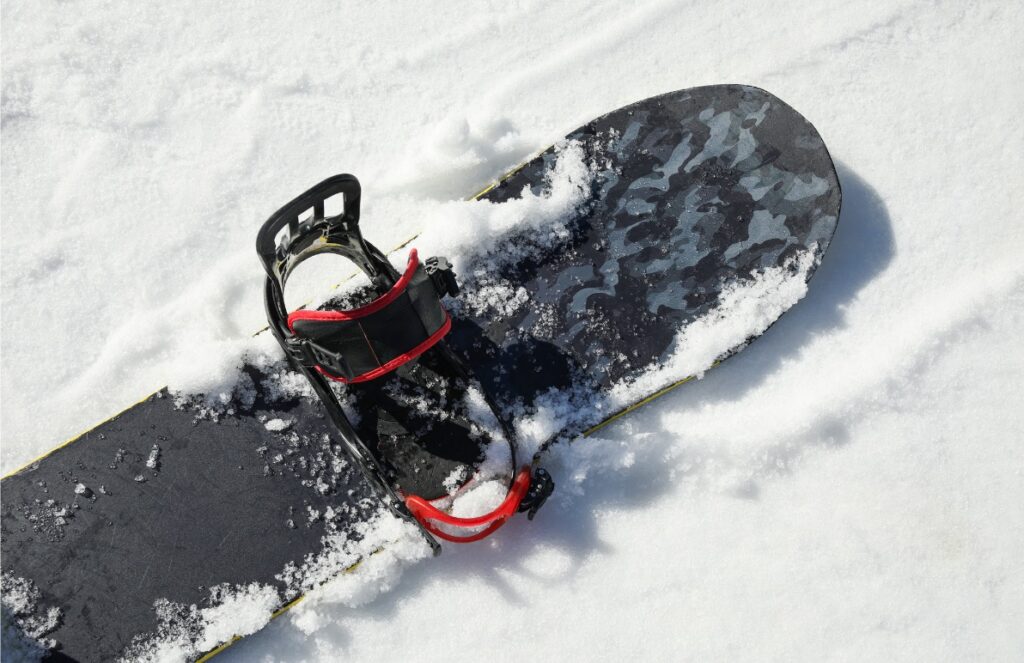
The next important spec to pay attention to is board flex. Board manufacturers’ and merchants’ websites usually detail board flex on a scale of 1 to 10, or 1 to 5, with 1 being soft and 10 being the stiffer end of the scale.
Beginners should buy boards that are on the softer end of the spectrum to be more forgiving when learning how to turn. Medium stiffness boards and above should be reserved for riders who already know how to turn and are exploring more of the mountain.
For more details on board flex, check out our article “Soft vs Stiff Snowboards: Choosing the Right Flex for Your Level.”
Board profile
Put in simple terms, board profile is how a snowboard is designed to bend and not bend. There are many different board profiles that exist. The main board profiles are:
- Camber;
- Reverse camber, aka rocker;
- Flat camber;
- Hybrid camber.
Beginners are well served by profiles that minimize the likelihood of catching an edge when learning to turn. The best snowboard profiles for beginners are:
- Hybrid – camber with rockered nose and tail;
- Hybrid – Flying V – camber underfoot with rocker between the bindings and at the tips;
- Flat camber.
To learn more about the different types of snowboard profiles, check out our article, “Which Snowboard Profile Is Best for Beginners?”
Board shape
Board shape falls into two main categories:
- Twin shape, which are completely symmetrical and work the same with either their noses or tails pointed downhill, and;
- Directional shape, which are designed to work better with their noses downhill.
There is a whole world of directionally shaped boards to explore when riders are past the beginner stage.
For beginners, twin shaped boards offer the best versatility while speed and direction control are being learned.
Riding switch, i.e., with your unnatural foot forward, is a fundamental skill for snowboarders to learn. A twin-shaped snowboard can greatly help with that learning.
To take a deep dive into snowboard shapes, check out our article, “How to Choose the Right Snowboard Shape for Your Riding Style.”
Conclusion
Choosing the right board will help a beginner snowboarder progress more quickly than if they’re on the wrong one. If you think you’re on the wrong snowboard, check out our article, “Is Your Snowboard Too Advanced for You?”
The most important thing to begin with is making sure your snowboard is the right size. A board that is too long will be hard to turn with agility and a board that is too short will make it hard to balance.
Next, making sure you have a soft board with a forgiving profile, such as rockered tips, and a twin shape will ensure you’ve got the right tool to learn this beautiful sport.