When riders struggle with foot pain, delayed edge response, or burning calves on the hill, they almost always blame their board or their own technique. But in reality, your bindings are the critical link translating force from your boots straight into your edges.
If your binding size doesn't match your boot profile, you end up over-tightening straps to compensate for excess play, leading to numb toes, pressure points, and sloppy turning.
Below, we break down universal and brand-specific sizing charts, how to handle borderline sizes, and the exact steps to check your fit at home.
What Size Snowboard Bindings Do I Need?
When choosing snowboard bindings it is important that you get the right size so that your boot is held securely and your foot in comfortable in the binding.
Most brands produce bindings in 3 different sizes: small, medium and large. Bindings have a good amount of adjustability meaning that each size can be altered to fit over a range of shoe sizes.
What to Do If You’re Between Sizes
One of the most common questions we hear is: “My boot is a US Men's 10 (or 8.5). The chart says Medium stops at 10 and Large starts at 10. Which size should I choose?”
When you sit right on the border between two sizes, use the following guidelines to help you decide.
1. Check your boot’s outer shell footprint
Not all boot models share the same external length, even if they share the same tag size.
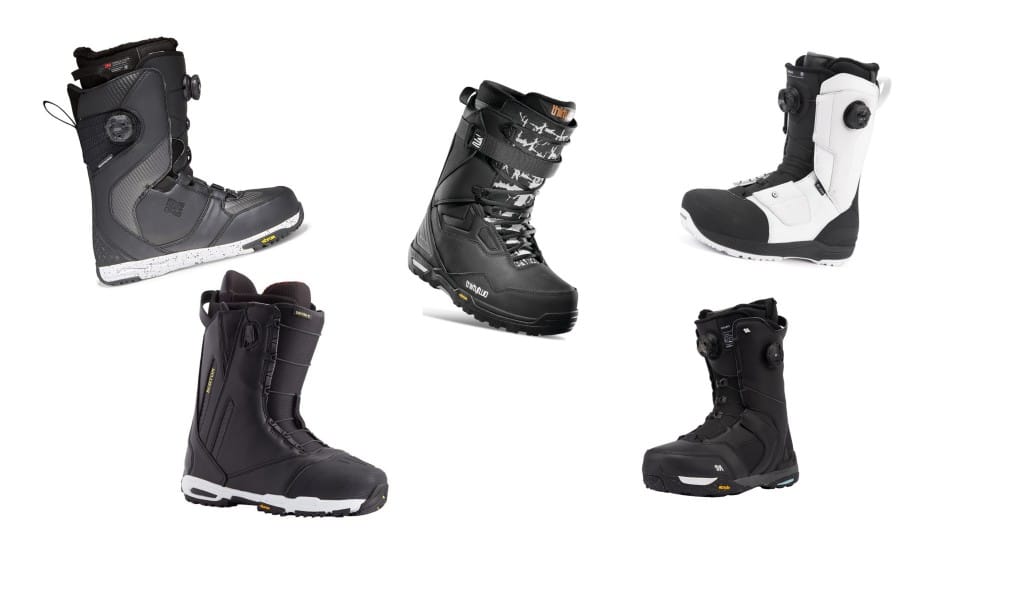
Reduced Footprint Boots (Size Down): Many manufacturers design boots with condensed outer shells (often referred to as “shrinkage technology” or compact lasts). A size 10 boot with this tech often shares the exterior dimensions of a standard size 9. If your boots have a reduced footprint, size down to the smaller binding so your boot sits flush in the heel cup without unwanted play.
Bulkier Boots (Size Up): Traditional lace boots or high-volume models have thicker outsoles and wider profiles. If you try to squeeze a bulky boot into a smaller binding, the sidewalls will squeeze the shell, restricting circulation and leading to painful arch cramps. In this scenario, size up to the larger binding.
2. Match your riding style
Why Freestyle Riders Prefer Sizing Down: A compact binding chassis eliminates empty space inside the heel pocket. For park laps, buttering, and side hits, this immediate, play-free connection makes edge swaps and rail adjustments feel effortless.
Why Freeriders & Carvers Prefer Sizing Up: When laying down aggressive carves at speed, you need full platform support underneath the balls of your feet. Sizing up provides a wider, longer baseplate and ensures the adjustable toe ramp extends far enough to support your toes during heavy edge loading.
Instructor Rule of Thumb for Borderline Sizes When in doubt, always prioritize baseplate width over strap length. Straps and ladders can be adjusted out using tool-less adjusters, but a binding chassis that is physically too narrow will crush your foot and ruin your day on the mountain.
How to Adjust Your Bindings to Fit
Bindings can be adjusted in a few different ways to modify the fit to your boot size.
Firstly the base plate can be adjusted to fit the length of your boot. On most models the toe ramp can be moved so that it sits right under the toe of our boot so that when you push down you can put all the pressure from your toes into the board.
The heel cup can also be extended at the back of the binding, to allow you more room for the heel of the boot. You should balance out how much you adjust the toe ramp and heel cup so that you foot is centered in the binding.
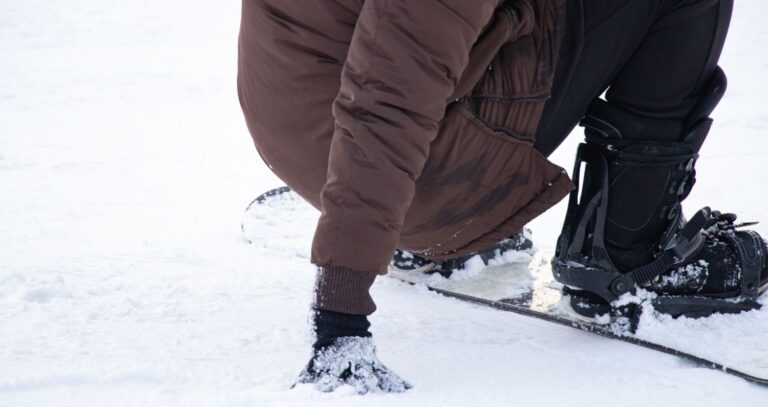
Binding straps can be adjusted to hold your boot securely. Both the ankle straps and toe straps should be set so when they are tight they are aligned in the middle of your boot.
Brand Specific Binding Size Charts
Arbor
Binding Size
Shoe size (US)
Shoe size (EU)
S/M
7-9
40-42
M/L
9-11
42-44
L/XL
11-13
44-47
Bent Metal
Binding Size
Shoe size (US)
Shoe size (EU)
S
5-8
38-41
M
8-11
41-44
L
11-14
44-48
Burton
Men's sizes:
Binding Size
Shoe size (US)
Shoe size (EU)
S
6-8
39-41
M
8-11
41-44
L
10+
43+
Women's sizes:
Binding Size
Shoe size (US)
Shoe size (EU)
S
4-6
34-36.5
M
6-8
36.5-40
L
8+
40+
Flux
Men's sizes:
Binding Size
Shoe size (US)
Shoe size (EU)
S
5-6.5
38-39
M
7-9.5
40-43
L
10-13+
43-47+
Women's sizes
Binding Size
Shoe size (US)
Shoe size (EU)
XS
5-7
38-40
S
7-9
40-42
L
10+
43+
Flow
Men's/youth sizes:
Binding Size
Shoe size (US)
Shoe size (EU)
XS
11Y-1
29.5-32
S
13Y-4.5
31.5-36
M
4.5-8.5
36-41.5
L
7.5-11.5
40-45
XL
10.5-15
44-49.5
Women's sizes:
Binding Size
Shoe size (US)
Shoe size (EU)
M
6-10
36-41.5
L
9-13
40-45
Jones
Men's sizes
Binding Size
Shoe size (US)
Shoe size (EU)
S
5-7.5
36.5-40
M
7-10.5
39-43.5
L
10-13
43-47
Women's sizes
Binding Size
Shoe size (US)
Shoe size (EU)
S
5.5-8.5
36.5-40
M
8.5-10
39-42.5
K2
Bindings with Profusion/Tripod Chassis
Men's sizes:
Binding Size
Shoe size (US)
Shoe size (EU)
M
5-9
36-41.5
L
8-12
40.5-44.5
XL
11-15
44.5-50
Women's sizes:
Binding Size
Shoe size (US)
Shoe size (EU)
M
6-10
37-41
L
9+
40+
Clicker X HB Bindings
Men's sizes:
Binding Size
Shoe size (US)
Shoe size (EU)
M
6-10
39-43
L
10-14
43-47
Women's sizes:
Binding Size
Shoe size (US)
Shoe size (EU)
M
5-9
35.5-40.5
L
7-11
37.5-41.5
Nitro
Men's sizes:
Binding Size
Shoe size (US)
Shoe size (EU)
S
3.5-7
35-40
M
7-10.5
40-43.5
L
11-14
44-47
Women's sizes:
Binding Size
Shoe size (US)
Shoe size (EU)
M
3.5-7
34.5-37.5
L
7.5-11
38-41.5
Now
Men's sizes:
Binding Size
Shoe size (US)
Shoe size (EU)
S
5-7.5
37-40.7
M
7-9.5
40-42.5
L
10-13
43-46
Women's sizes:
Binding Size
Shoe size (US)
Shoe size (EU)
S
5.5-8.5
34.5-39
M
8-10.5
38.5-41
Ride
Men's sizes:
Binding Size
Shoe size (US)
Shoe size (EU)
M
5-9
37-42
L
8-12
41-45
XL
11-15
44-48
Women's sizes:
Binding Size
Shoe size (US)
Shoe size (EU)
S
4-7
34-37.2
M
7-11
37-41.5
Rome
Men's sizes:
Binding Size
Shoe size (US)
Shoe size (EU)
S
5-7.5
37-40
M/L
7-10.5
39-44
L/XL
10-12
42.5-45.5
Women's sizes:
Binding Size
Shoe size (US)
Shoe size (EU)
S
6.5-9
36.5-40
M/L
8.5-12
39-44
L/XL
11.5-13.5
43-45.5
Salomon
Men's sizes:
Binding Size
Shoe size (US)
Shoe size (EU)
S
3-7
35-40.5
M
6.5-10
39.5-44
L
10-15
44-50
Women's sizes:
Binding Size
Shoe size (US)
Shoe size (EU)
S
4-8
35-38.5
M
7.5-11
38-44
L
11.5+
44.5+
Union
Men's sizes:
Binding Size
Shoe size (US)
Shoe size (EU)
S
6-7.5
38-40.5
M
8-10
41-43
L
10.5+
44+
Women's sizes:
Binding Size
Shoe size (US)
Shoe size (EU)
S
4-6.5
34-37
M
5-6.5
38-40.5
L
7-9
41-43
3 Steps to Verify Your Fit at Home
Once you have your bindings in hand, place your unstrapped boot directly into the chassis to check these three key touchpoints before mounting them to your board:
1. Check heel cup contact
Slide your boot heel firmly back into the binding. The boot should rest flush against the highback and heel cup without forcing or bowing the sidewalls. There should be minimal side-to-side slop.
2. Extend the toe ramp
The adjustable ramp underneath your toes should extend so the ball of your foot and the curve of the sole are fully supported. If the ramp is too short, you lose leverage on toe turns ; if pulled out too far, it creates dead space.
3. Center your straps
Ratchet the ankle and toe straps down snug. The padded sections should sit centered over the spine of your boot and the front of your toe box. If a strap sits off to one side, use the tool-less adjusters on the ladder spine to re-center it.
Binding Sizing vs. Snowboard Waist Width
Getting your binding size right is only half the battle. You also need to ensure your binding and boot dimensions match your snowboard’s waist width:
Preventing Boot Drag: If you wear a US Men's 11+ boot and ride a Large binding, standard board waists will often be too narrow. Your toes or heels will catch in the snow during deep carves, causing sudden washouts.
Checking Your Dimensions: Check our Snowboard Size Calculator to verify that your board width matches your boots and bindings.
Conclusion
Nailing your binding size isn't just about reading a table—it’s about eliminating sloppy heel lift and painful pressure points so every ounce of energy goes straight into your edges.
Use the charts above to find your bracket, double-check your boot’s outer footprint if you're on the border, and take five minutes at home to center your straps and toe ramp before you head to the resort.
Once your boots and bindings are working together as a seamless unit, your board will feel more responsive, your feet will stay fresh all day, and you can focus entirely on riding.
Written by Graeme Gibson
I've spent the last 25 years riding my snowboard all over the world. I now live in Switzerland with my family where I coach snowboarding and still get a few powder days in whenever I can.
Learn more about me here.