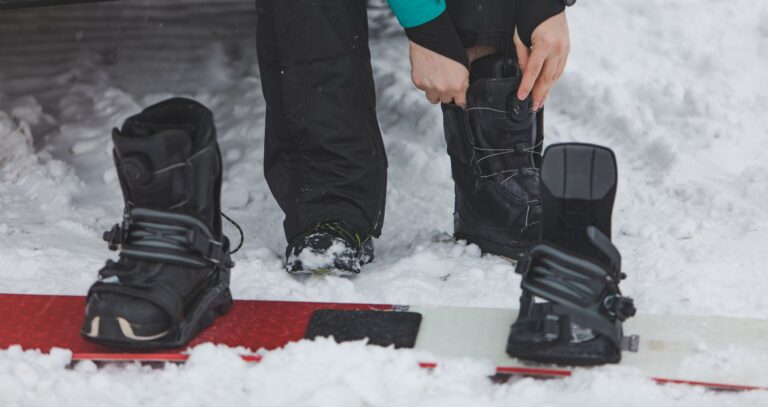

Snowboard bindings are one of the key pieces of snowboard equipment, along with your boots and the snowboard itself.
There are a ton of different snowboard bindings out on the market and they fall into two distinct categories:
- Strap bindings
- Quick-Entry bindings
Strap bindings, as the name suggests, use the traditional two-strap system to fasten a rider to their board.
Quick-entry bindings include:
- Rear-entry bindings
- Step-in binding systems
- FASE® bindings
Despite these distinct categories, all snowboard bindings share some essential components in common.
This article will begin by going over those main parts all snowboard bindings share in common before covering some of the specialty parts that are found on some bindings.
Increasing your knowledge about snowboard bindings will help you to know exactly what to look for when purchasing a new set of bindings, or to know which part to replace when it reaches the end of its life.
And trust me, it happens to all snowboarders: buckles fail and straps break. If a baseplate breaks, that’s another story and you shouldn’t hesitate to contact the manufacturer.
The Main Parts of a Snowboard Binding
Modern snowboard bindings all share a certain number of components in common. This section will go over those components.
The highback and forward lean adjustment mechanism
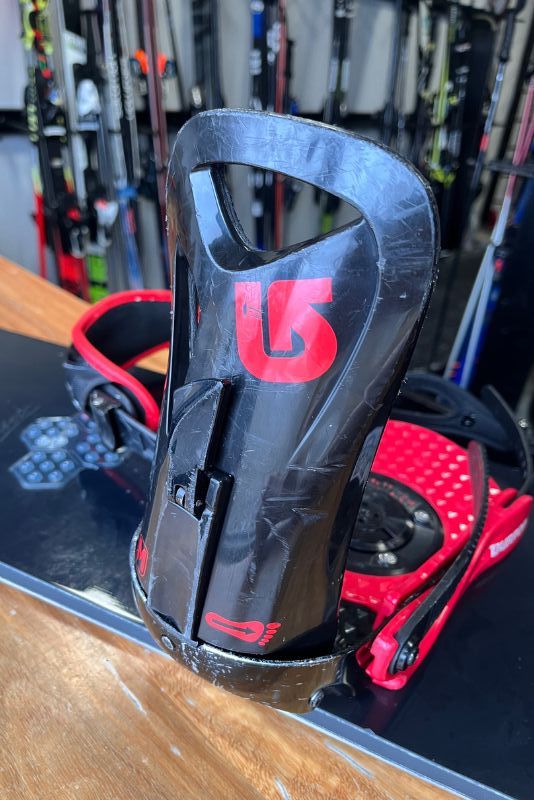
The highback is the vertical piece that rises up from a snowboard binding to support the back of your snowboard boot.
Highbacks are generally made of composite plastics which offer a varying degree of flex to meet the snowboarder’s needs. Some higher-end highbacks are made with lightweight carbon fiber.
The majority of highbacks have a mechanism to adjust the amount of forward lean. Forward lean can be a great tool to improve the energy transfer between our lower-body movements and the snowboard and help riders bend their knees.
Forward lean adjustment mechanisms vary between brands. Some use a quick-release screw, others use a dial, and there are other mechanisms still.
The straps and strap components
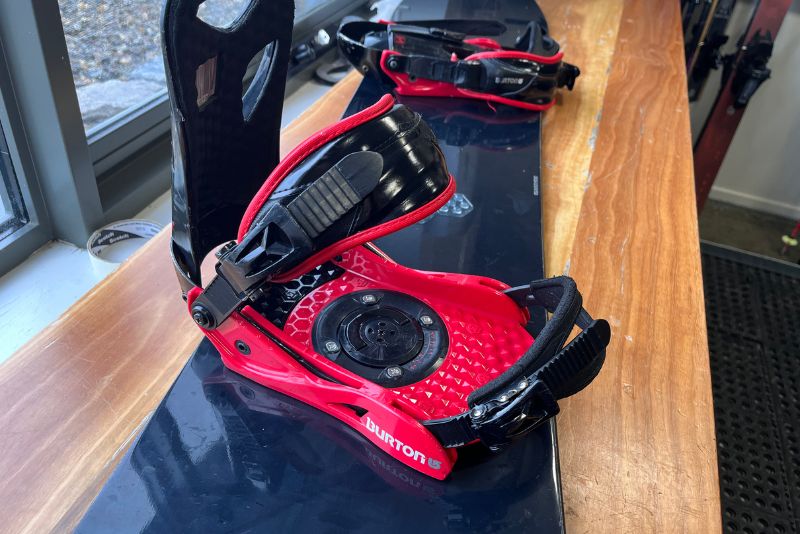
Straps are the components of a snowboard binding which actually fasten you into the binding. Snowboard straps are found on both traditional strap bindings, rear-entry bindings, and FASE® bindings, but are not present on step-in systems.
Traditional strap bindings have two straps: a heel strap and a toe strap. Although, the term “toe strap” is being replaced by “toe cap” to reflect advancements in technology.
Toe caps, which have largely replaced toe straps, are 3D molded caps which hug around the toe of your snowboard boot, as opposed to flat straps which sit on top of your toes. This technology allows the strap to pull your boot back towards the heel cup of the binding all while securing the front of the boot to the board.
Straps have four components, the:
- Ladder strap with notches to adjust tightness;
- Slider, which has holes to adjust length, and which connects to;
- Toe / heel strap respectively, and;
- Buckle, which is fastened to the strap and connects it to the ladder strap when tightened.
It should be noted that heel and toe straps have specific components and cannot always be mixed. Meaning for example, you can’t buy a toe strap buckle and fit it onto a heel strap so make sure to buy the specific part you need if replacing components of your bindings.
Also, be aware that components from different brands are not always compatible with each other. It’s best to buy replacement components from the same brand as your setup.
The base plate, heel cup, and footbed
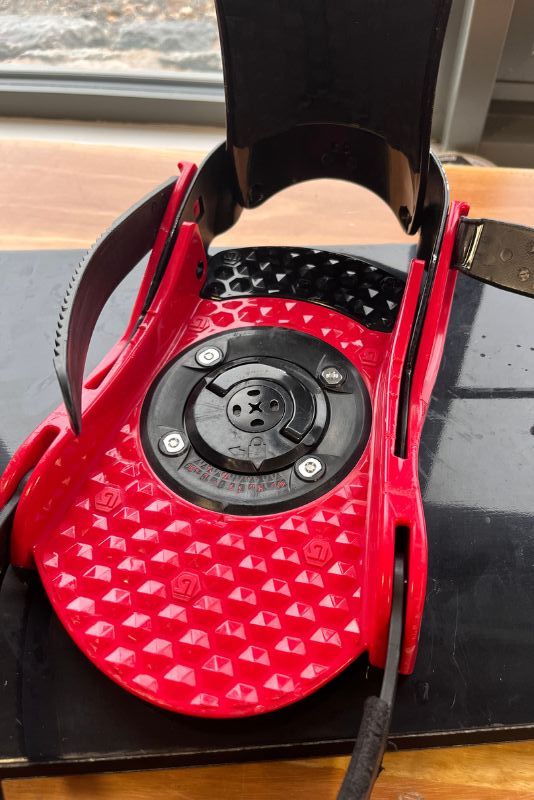
The base plate is the part of the snowboard binding which gives the binding its main structure and houses the mounting system which fastens the bindings to the board (4×4 discs or channel systems).
The heel cup, which curves around the heel of the boot and provides support for the highback, is either integrated into the base plate in a single molded piece or attached via a hinge.
The footbed is a layer of molded foam which sits on top of the base plate to add a layer of cushioning under the rider’s boot. For an ergonomically correct position, consider purchasing after-market canted foot beds to incline your feet slightly inwards.
Specialty Snowboard Binding Parts
This section will explore the specialty snowboard binding parts which are unique to the different systems that exist.
The first three sub-sections are focused on tech used in Quick-Entry systems, whereas the last section which explores Skate Tech will detail a technology which can be found on both strap bindings and quick-entry systems.
Rear-Entry systems
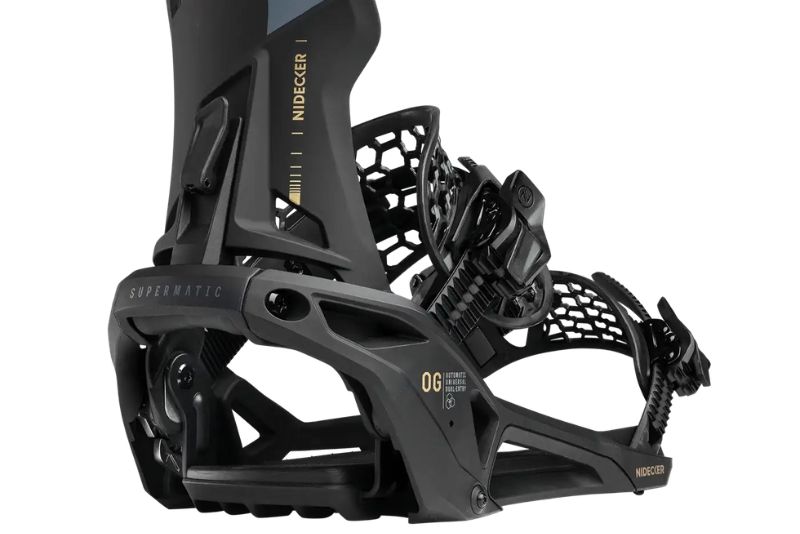
Rear-entry systems allow the highback to fold down backwards, allowing the snowboarder to step into the bindings. The highback then folds back up to an upright position and locks the boot in place, without the need to adjust the straps.
Rather than using the traditional two-strap system, many rear-entry systems use hybrid or fusion straps.
Hybrid straps, such as those made by Nidecker, use a small extension strap to connect the heel strap to the toe strap. These are almost exclusively used in rear-entry systems.
Fusion straps are another type of strap exclusively used in rear-entry binding technology. They are one big strap that fits snugly over the front of the boot rather than two separate straps. As an example, Nidecker has designed a line of fusion straps.
Step-in systems
Step-in systems use hook and cleat mechanisms to fasten your boots to the bindings. The cleats are integrated into compatible boots and the hooks are located at the back of the boot and on either side of the toe.
There is a lever next to the highback which releases the hooks and allows the rider to step out of the binding.
The most widely known example of this is Burton’s Step On® system which has been licensed by other brands for their own lineups.
FASE® systems
The newest iteration in binding technology is called the FASE® Fast Entry System. It is argued that the FASE® system is neither rear-entry, strap, nor step-in but rather a combination of all of the above.
The FASE® system has a fold-down highback, adjustable straps, and a system that clicks into place when stepped into.
Major brands like Jones and Rome have licensed this system and integrated it into their lineups.
Skate Tech
Skate Tech is a system developed by JF Pelchat at NOW Bindings. NOW uses this system in all the bindings in their impressive lineup. The Skate Tech system has since been licensed by Jones and integrated into several of the bindings in their lineup.
Essentially, Skate Tech uses a kingpin mechanism, like a skateboard, to allow the bindings to pivot from heel edge to toe edge. They also incorporate adjustable dampeners to customize the smoothness of your edge-to-edge transitions.
Conclusion
Amidst the varying technologies and competing brands that exist in the snowboard binding space, there are a number of components that are standard.
Knowing how to identify which piece of your bindings needs replacing or which features you’d like to learn more about is a big step in the journey to becoming an informed snowboarder.
Next time you’re chatting snowboarding with someone on or off the hill, ask them their thoughts on quick-entry vs strap bindings. Ask them if they’ve ever tried FASE® or Skate Tech.
Remember, we all have our preferences and the perfect system is the one that suits you best!
Next Up in Snowboard Bindings:
How to Choose the Right Snowboard Bindings (Flex & Fit Guide)
This article covers basic fit checks and flex decision making guidelines to help you choose a set of bindings.