
Back in the day when I was an intermediate snowboarder, I remember borrowing a friend’s snowboard and finding it so stiff that I could barely control it! It felt like riding a plank of plywood down the hill.
However, for my friend who was a much better snowboarder than I, the board was just the tool they needed to shred the mountain in the way they wanted to.
Now that I’m an expert rider, I understand why someone might choose a stiff board, but I know that a medium/stiff flex is what suits my riding style the best.
If, like I did, you sometimes feel like you’re riding a plank of plywood rather than a snowboard, then maybe you bought a stiff board without knowing it.
Learn More: Is Your Snowboard Too Advanced For You?
Snowboard stiffness is one of the key specs to consider when choosing a snowboard and this article will dive into how to choose the right flex for your level.
Ask yourself a couple of questions first
There are a couple of key questions you should ask yourself to help determine what flex will serve you best.
Read through these questions first and then we’ll dive into how and why snowboards flex.
What level of snowboarder are you?
The first question you need to ask is, “What level of snowboarder am I?” If you don’t know the answer to this question, check out this article here.
Generally speaking, snowboarders towards the beginner to low-intermediate end of the spectrum will be best served with a soft to medium board.
As skill level progresses beyond that point, snowboarders can begin to think about getting a stiffer board.
Snowboards rated “stiff” should be used by advanced and expert riders, because of the board performance and resulting energy they can produce.
What kind of snowboarding do you want to do?
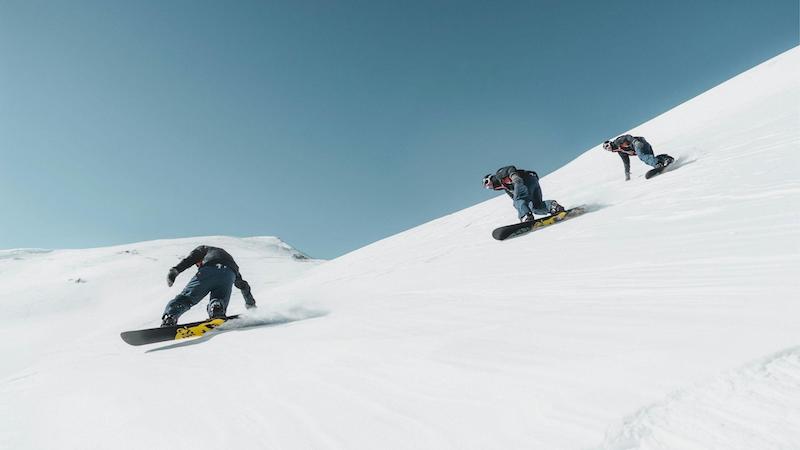
Do you want to ride fast through choppy terrain and create dynamic, high-energy, bouncy snowboarding? If yes and you have the skill set, then you will be well served with a stiffer board because it will deliver stability at higher speeds and energy on demand.
Do you want to play, make short turns, and dance down the mountain? If yes, you’ll be better served by a medium flex board which will be more agile than something more stiff.
Are you consolidating your turns and want to increase your feeling of control? If this is you, you’ll be best served with a softer board which will be forgiving when changing edges.
As board stiffness increases, snowboards can create and release more energy as they bend and rebound to their original shape. It takes more speed, strength, and skill to make them bend, but when they do, get ready to hang on for the ride!
How and why do snowboards flex?
Snowboards flex in a couple of different ways for a couple of different reasons. As a general rule:
- Softer snowboards are easier to turn, but will produce less energy;
- Stiffer snowboards are more challenging to turn, but will produce more energy.
The following sub-sections will go over the different ways that a snowboard bends and why it is designed to do so.
Tip to tail flex
This type of bend in a snowboard is felt by holding the board up in front of you with its tail on the ground and with one hand holding its nose.
By pushing with your other hand into the snowboard’s waist, you can feel two things:
- The resistance to being bent, i.e., is it soft, meaning easy to bend, or is it stiff, meaning it takes effort to bend it.
- The rebound, i.e., how much “kick back” is there when you release the bend? A lot or a little?
As we make turns on the snow with our boards, we push against those turns with our bodies and bend the board with each turn.
When we get efficient at this and purposely bend the snowboards more and more, we create and store energy in the board which can be released into the next turn. This creates what we call board performance which creates dynamic snowboarding.
Torsional flex
This type of bend in a snowboard is the amount it can twist from heel edge to toe edge.
It can be felt by strapping into the board and pulling up with one toe and pushing down with the other.
Although there are more applications, torsional flex is useful in snowboarding for two main things:
- In turns, “pedalling” the board, which can be used to get grip on either the front or back of the board by flexing or extending one ankle in opposition to the other.
- In the park, “hugging” a rail by twisting the board to grip it between the heel and toe edges, resulting in a locked-in feeling.
Torsional flex is largely related to fiberglass layering and whether it is biaxial or triaxial; with triaxial delivering stiffer torsional flex.
As you might have guessed, biaxial fiberglass layering is two layers of glass, often laid with the grains at 90° from one another. Triaxial has a third layer running at 45° from the perpendicular layers.
For snowboarders looking for ease in edge changes or the ability to grip a rail, biaxial might be the way to go.
For riders looking to create maximum board performance, a torsionally stiff board will serve them well.
Stringers
A way to increase stiffness is with the addition of stringers in a board’s design.
Stringers are pieces of material, often carbon which is both strong and light, added between on top of a snowboard’s wooden core to increase stiffness.
They can be added top to tail to increase stiffness along the length of the board, or angles across the board to increase lateral stiffness.
Side note, stringers are often found in surfboard design as well!
How to determine a snowboard’s flex?
The best way to truly understand a snowboard's flex is by strapping into it and going for a ride.
Try pedalling, pumping turns, doing flatland tricks and ollies and finding out what feels good and what doesn't.
The second best hands-on way to learn about flex is to go to a board shop and try, as mentioned above, the waist push test. Then if the shop allows you, strap in and test torsional flex and feel the stiffness through basic flatland tricks like nose and tail presses.
The last way to determine a snowboard’s flex is by reading the specs on the board’s information sticker, or on the manufacturer’s or reseller’s website; check this page out and scroll down to product specs as an example.
Conclusion
As a generalization, we can say that stiffer boards are built for more advanced riders as they require more skill to bend and to handle the board performance that bending creates.
Softer boards make it easier to initiate turns, through pedalling, and can also make it easier to balance on rails, through “hugging.”
Boards bend from tip to tail and also from edge to edge. Knowing your riding style and ability level can help you make choices on how stiff of a board you like to ride.
As an expert rider who loves playful and creative riding, a medium-stiff board suits me well. How about you?!