
There is a wide world of snowboards out there, each with their own shapes, sizes, profiles, stiffnesses, and bends. It can be a bit daunting to navigate until you know the language.
As a career snowboard instructor, I’ve had the pleasure of helping a countless number of beginner and intermediate snowboarders purchase their first or second snowboard set up, making sure they don’t purchase something too advanced or something unsuitable for their style.
This article will explore and explain the topic of shape, specifically the two main shape categories: directional and twin.
What is snowboard shape and why does it matter?
Snowboard shape is largely defined by two things:
- the size of the nose and tail of your snowboard, and;
- the placement of the binding inserts and sidecut.
There are two main categories of shape: directional and twin.
Simply put, directional snowboards work best with the nose of the snowboard going downhill first and twin snowboards work equally as well with either the nose or the tail pointing downhill first, that is natural or switch.
Natural means riding in your normal stance, regular or goofy, i.e., left-foot or right-foot forward. Switch means riding in your unnatural stance, i.e., goofy if your natural stance is regular and vice versa.
Read more: Snowboard Shapes Explained
Directional snowboard shape explained.
Directional snowboards are designed to go down the hill with their nose forward. To this end, they have longer noses and shorter tails. The reference stances are set back from center as well as the sidecut radius.
Some directional snowboards have a tapered tail, meaning the tail is narrower than the wider nose. This helps the tail sink and the nose stay up in powder.
Snowboards with a tapered tail are often called Freeride Directional Snowboards; whereas All-Mountain Directional Snowboards will have equal nose and tail width.
Twin snowboard shape explained.
Twin snowboards are generally symmetrical from the center of the snowboard out to the nose and tail.
The reason is that these boards are designed to work equally well with the nose or the tail pointed downhill.
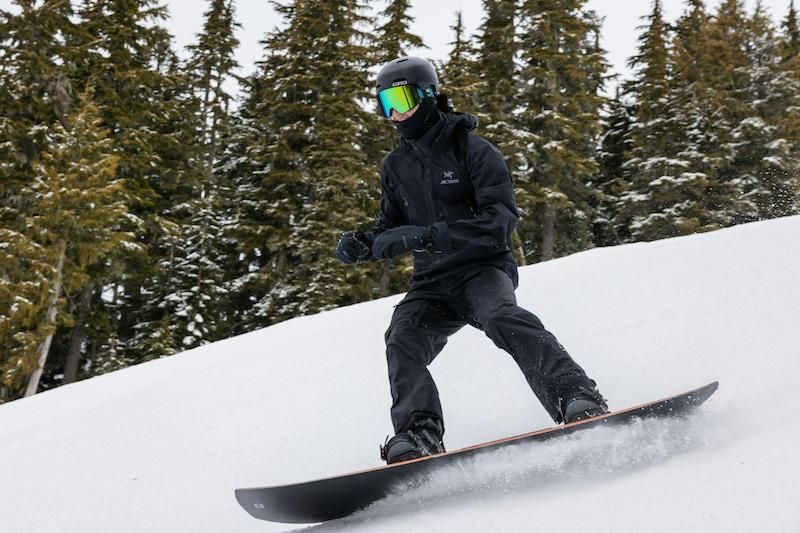
The most common application for this kind of board is freestyle riding, where snowboarders need to be able to perform equally well natural or switch.
How to identify directional and twin snowboards.
There are a few details on a snowboard spec sheet that can tell us about its shape. Some of those details include:
- Nose and tail length
- Nose and tail width
- Reference stance location
Twin snowboards will generally have equal nose and tail length and width, and a reference stance of 0, meaning right in the center of the board.
Directional snowboards will generally have a set back reference stance, i.e., -12.5cm, and a longer nose than tail.
If there is a difference in nose and tail width, i.e. a tapered tail, it indicates that the board is meant more specifically for powder rather than all-mountain, variable conditions.
Not sure what snowboard length to ride? Learn how to choose a snowboard here.
How to identify and measure the nose and tail of a snowboard.
All snowboards have a nose and a tail. To determine which is which, try the following steps:
- Hold your board in front of you with one of its ends on the ground and look to see that the writing is not upside down and/or that the graphic is in the correct orientation.
- Once the correct orientation is determined, the tip of the board that is touching the ground is the tail and the other end, likely in your hand, is the nose.
Now that you’ve identified the nose and the tail, you can simply have a look or use a tape measure to determine if the nose and tail are the same length or different.
To use a tape measure, first locate the reference stance on the binding inserts. Read the next section to learn how to do that.

How to identify the reference stance of a snowboard.
The inserts of a snowboard are the place where we attach our bindings to the board. Inserts can be screw holes (i.e., commonly known as inserts) or a channel.
Inserts and channels always have a reference stance marked by either “REF” or an arrow or some graphic indicating which holes or position are the reference stance.
Reference stance means that if bindings are mounted directly on that stance, they will be positioned in the center of the sidecut and the snowboard will be placed in the optimal position to make the snowboard ride the way it was designed to.
To learn more about sidecut, keep reading.
If you need a wider or narrower stance, bindings should always be moved equally from the reference stance. That is, if you widen your stance, you should move both bindings out at equal distance from the reference stance.
Instructor Insight: The number of people who unknowingly have their stances set back at unequal distances from the reference stance is staggering. It can lead to the feeling that your snowboard is “running away” from you and is difficult to control or make it turn.
What is the sidecut radius on a snowboard?
Snowboards have a parabolic shape, meaning they have a wider nose and tail and a thinner waist (i.e., the part of the board between the bindings). This results in a curved cut-out along the side of the board; the arc of a larger circle.
This arc is what makes a snowboard want to create a round turn on the snow when we put it on its edge. By continuing to draw the circle along the arc of the snowboard, we can determine the size of the full circle the arc is part of.
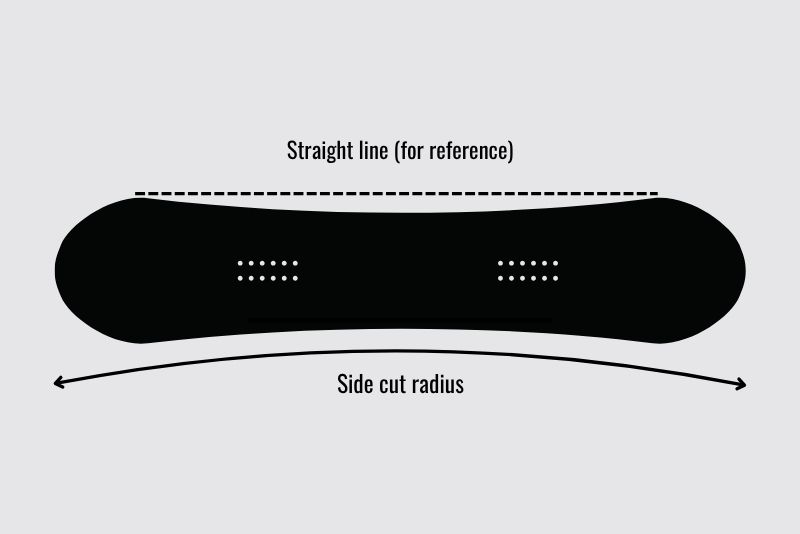
The full circle can be big or small, which determines if the snowboard is designed to make big or small turns on the snow. Snowboard manufacturers detail the sidecut radius in their board specs to tell us about the arc.
A smaller sidecut radius will make the snowboard turn more quickly; whereas, a larger sidecut radius will make the snowboard make bigger turns and be more stable at higher speeds.
What does sidecut radius have to do with snowboard shape? Often, directional snowboards will have a set back sidecut to match the longer nose and the reference stance of the binding inserts.
Conclusion
Now that you’ve read this article, you should be able to explain and understand the difference between twin and directional snowboard shape.
You should also know that if you plan to ride a lot of switch, then a twin shape is your best choice. Conversely, if you plan to ride mostly all-mountain, then a directional shape will serve you well.
Lastly, if you’re mostly going to be riding fresh, deep powder, then you can look for a tapered tail to help you float your way down the mountain.